
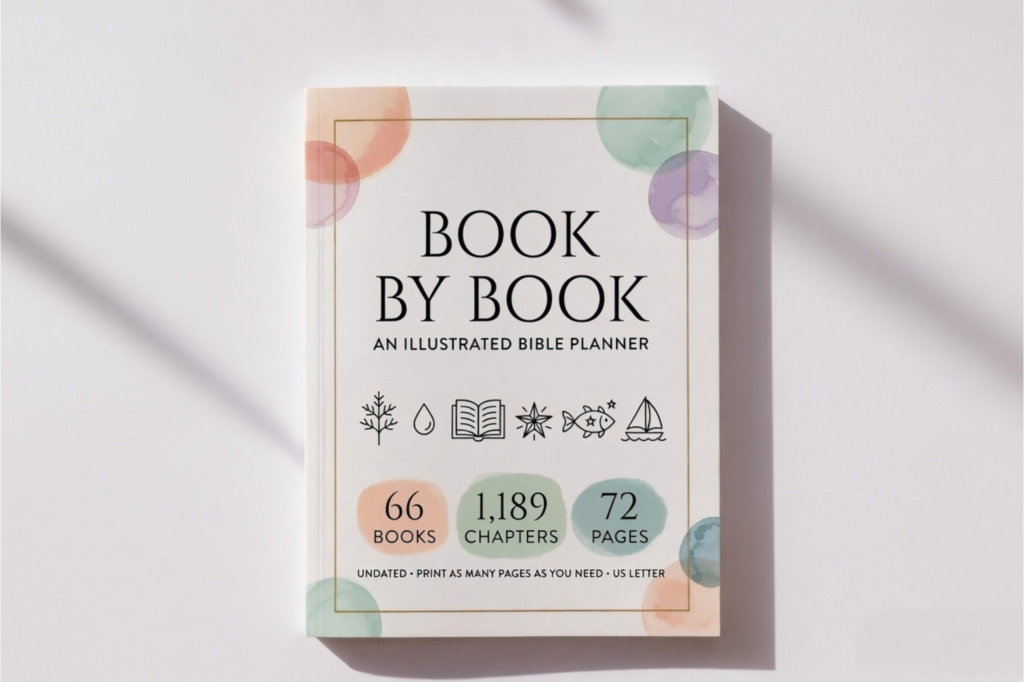
Book by Book is a 72-page illustrated Bible reading planner with one dedicated page for every book of the Bible — 66 in total. Each page gives you the book’s overview, themes, and key people, a chapter tracker sized to the real chapter count, and space to write out verses by hand. It’s undated, so there’s no missed week to catch up on and no reason to wait for January. It’s part of Pablocity’s wider planners & toolkits collection.
If you’ve started a reading plan before and quietly stopped somewhere around Leviticus or the minor prophets, this is built for exactly that experience — not as a failure to fix, but as the normal shape of reading a very long book.
The Problem With Most Bible Reading Plans
Most plans are built around a calendar. Day 47. Week 12. Miss four days in Leviticus and the whole thing starts to feel like a debt you owe it, not a book you’re reading. That’s usually where people quietly stop — not because they lost interest, but because the system they were using only had one setting: on schedule or behind.
That drop-off shows up in the numbers, too. One dataset from Bible Gateway, reported by Christianity Today, found that participation in year-long reading plans fell by a third by the end of February and by half by May — the same pattern most people recognise from their own attempts.
A book-by-book approach removes the clock entirely. You pick up wherever you already are — Psalms, Romans, halfway through Judges — and the page in front of you doesn’t know or care how long you took to get there. There’s no missed-day counter and no “restart from Day 1” button, because there’s no Day 1 to begin with.
This matters more than it sounds like it should. The Bible isn’t one book — it’s 66, written across roughly 1,500 years, in at least three languages, by dozens of different people. Treating it as a single 365-day sprint flattens that. Treating it as 66 separate books, each with its own shape and pace, is closer to what it actually is.
| Dated reading plan | Book by Book | |
|---|---|---|
| Structure | Fixed daily/weekly schedule | One page per book, any order |
| Miss a week | Falls behind, hard to resume | Nothing to fall behind on |
| Starting point | Day 1 only | Any book, any time |
| Translation | Often built around one | Verse boxes left blank for any translation |
| Pace | Same speed for every book | Genesis and Obadiah get the space they actually need |
| Best for | People who want a fixed daily habit | People who’ve started and stopped before |
What’s Inside the Planner
Every book gets a full page built the same way, so once you know how to read one page, you know how to read all 66:
- Overview — a plain-language summary of what the book is actually about, not a commentary. Where authorship is genuinely debated, like Hebrews or several of the historical books, the page says so instead of pretending there’s a settled answer.
- Key themes — five per book, so you know what to watch for before chapter one. Genesis gets creation, covenant, and faith tested. Job gets suffering, unhelpful comfort, and honest lament.
- Setting — one line placing the book in time and geography, from “Egypt, the Red Sea, and Mount Sinai” for Exodus to “the island of Patmos” for Revelation.
- Chapter progress tracker — one square per chapter, sized to the real count. Psalms gets a full grid of 150. Obadiah, the shortest book in the Old Testament, gets one.
- Book journey — the people you’ll meet, in the order you’ll meet them, so an unfamiliar book gets easier to follow. Judges lists Deborah, Gideon, Samson, and Jephthah before you’re a chapter in.
- Verses worth keeping — two blank boxes for copying out verses by hand, in whichever translation you’re actually reading.
- Reflections — open space, not prompts. Nobody needs another worksheet telling them what to feel about a chapter.
- Completion date — filled in only when you finish, not when you start.
The front matter adds a full progress page for the Old Testament’s 39 books and 929 chapters, and another for the New Testament’s 27 books and 260 chapters — each with a colour key across eight genres: Law, History, Wisdom, Major Prophet, Minor Prophet, Gospel, Letter, and Apocalyptic. Colour in a book’s circle on the progress page as you finish it, and the whole shape of the Bible slowly fills in.
A Look at One Page
Take the Genesis page as an example. The top third gives you the essentials in about thirty seconds: 50 chapters, traditionally attributed to Moses, set from creation to Israel’s family settling in Egypt. The overview line explains it as the origin story — creation, the entry of sin, the flood, and a covenant with one family meant to bless the whole world.
Below that sits the chapter grid: 50 numbered squares, five rows of ten, ready to be coloured in one at a time. Underneath the grid, six small character markers run left to right — Adam & Eve, Noah, Abraham, Isaac, Jacob, Joseph — the book’s cast in the order they show up, so a first-time reader isn’t meeting Joseph cold in chapter 37.
The bottom half is blank on purpose: two boxes for verses worth keeping, an open reflections space, and a line for the date you finish. Genesis takes as long as it takes. The page doesn’t rush it.
Four Ways to Start
If Genesis-to-Revelation in printed order isn’t the right entry point, the planner suggests three alternatives. Pick one, ignore the rest, and change your mind later — every page works the same way regardless of the order you read them in.
- New to the Bible (8 books) — John → Genesis → Psalms → Mark → Exodus → Romans → Proverbs → Acts. Starts with who Jesus is, then goes back to where the story begins. Built for someone who has never opened a Bible before and doesn’t want to start with genealogies.
- The story spine (14 books) — Genesis, Exodus, Joshua, Judges, 1 & 2 Samuel, 1 & 2 Kings, Ezra, Nehemiah, Luke, Acts, Revelation. The narrative thread only — how the story hangs together, without the poetry or the letters slowing it down.
- A hard season (7 books) — Psalms, Lamentations, Job, Habakkuk, Ruth, Philippians, 1 Peter. Books written by people who were grieving, angry, or waiting, and didn’t pretend otherwise. For a season when the usual encouragement verses feel thin.
- Straight through (66 books) — the complete route, in printed order. Slowest through Leviticus and the prophets — the planner says plainly that this is normal, not a sign anything’s wrong.
How to Use It
- Read the top of the page first. The overview, themes, and setting take thirty seconds and give you somewhere to stand before chapter one. Knowing a book is a courtroom argument, a war record, or a love poem changes how it reads.
- Colour in a chapter square each time you finish one. The squares are sized to the real chapter count, so the visual weight of a book matches how long it actually takes.
- Write the verses out by hand. The verse boxes are blank on purpose — copying a verse in your own handwriting holds it better than reading it twice, and it means you can use whichever translation you actually read.
- Follow the book journey. The illustrated strip shows who you’ll meet. Names first makes an unfamiliar book far easier to follow.
- Date it when you finish. The strip at the bottom is small on purpose. Sixty-six of them filled in is not.
Who It’s For
Because it’s undated and organised by book rather than by day, Book by Book tends to fit situations where a fixed daily plan falls apart:
- People who’ve tried a one-year plan and stalled. There’s no missed-day counter here to make restarting feel like a failure.
- New believers who don’t yet know where Obadiah sits relative to Ephesians, and want the shape of the whole thing before diving into any one part.
- Bible study groups, where each member is often reading a different book at a different pace — one shared format still works across the whole group.
- Homeschool and family devotion time, where a chapter tracker gives kids something visual to colour in as a book progresses.
- Gift-givers looking for something more personal than a generic devotional — the completion dates turn into a small record of when someone read what.
- Journaling Bible users who want a companion planner rather than something that duplicates the margin notes they’re already making in the text itself.
Printing Notes
Book by Book is sized for US Letter and designed to be printed as many pages as you need — one book at a time, a handful for the week ahead, or the full 72 pages at once for a binder. A few practical notes if you’re setting it up:
- Paper weight: a mid-weight cardstock (around 90–100 lb / 24–27 lb bond) holds up better than standard printer paper if you’re colouring the chapter squares with pencils or markers.
- Binding: a three-ring binder with the Old and New Testament progress pages up front works well as a growing record, since you can insert book pages in whatever order you’re actually reading them.
- Double-sided vs single-sided: printing single-sided keeps the reflections space fully usable and avoids bleed-through if you’re using markers rather than pencils.
- Colour vs black-and-white: the eight-genre colour key is there to help at a glance, but every page still works in black-and-white if that’s what your printer has.
Frequently Asked Questions
Is this planner dated? No. There are no dates anywhere in Book by Book. Every page is undated by design, so you can start with whatever book you’re currently reading and take as long as you need.
What translation does it work with? Any. The verse boxes are left blank on purpose, so you can copy out whichever translation you actually read.
Do I need to start at Genesis? No. The planner includes four suggested routes, including one that starts with the Gospel of John, and it’s built to work in any order.
How many pages is it? 72 pages: one page for each of the 66 books, plus Old and New Testament progress trackers, a how-to-use guide, four reading routes, and space for notes.
Is it printable? Yes. It’s sized for US Letter and designed to be printed as many pages as you need — one book, a section, or the whole set.
Can it be used in a group Bible study? Yes. Because each page stands alone and nothing is dated, a group can use the same format even if every member is reading a different book at a different pace.
Is it beginner-friendly for someone who has never read the Bible before? Yes. The “New to the Bible” route is built specifically for a first-time reader, and every book page opens with a plain-language overview before any chapter tracking begins.
Does it replace a journaling Bible? No — it’s designed to sit alongside one. The verse boxes and reflection space give you a place to collect what stands out, without duplicating the margin notes you’re already making in the text itself.
References
- Christianity Today — “Plan This Year’s Bible Reading for Endurance, not Speed”
Start Wherever You Already Are
Book by Book doesn’t ask what day it is. Pick the book you’re already reading, colour in the first chapter, and go from there. It sits alongside the rest of Pablocity’s Planners & Toolkits collection, and the broader digital products shop.